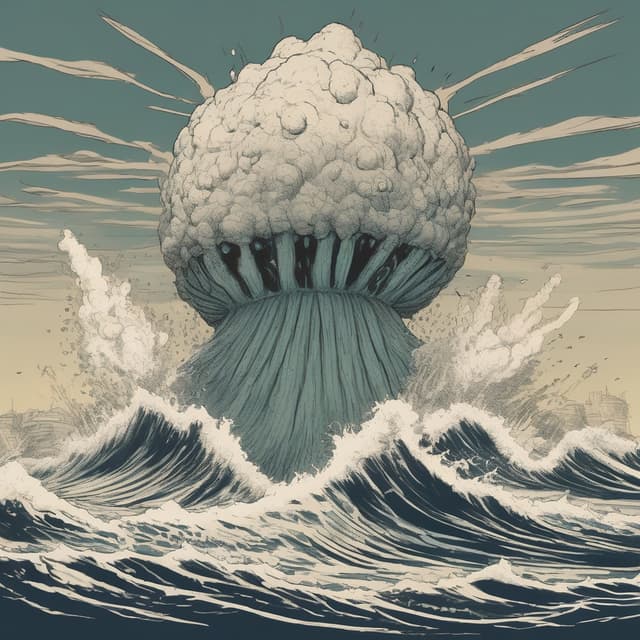
| Impact | Major shift in international military technology and cooperation • Allowed more effective combat against kaiju menace • Transformed international relations and nature of warfare • Impacts continue to reverberate through geopolitics |
| Purpose | Weapon against giant kaiju monsters |
| Capabilities | Inflict devastating damage on even the largest kaiju |
| Invention year | 2002 |
The invention of the anti-kaiju bomb in 2002 was a watershed moment in the ongoing global effort to defend against the growing threat of giant, destructive monsters known as kaiju. This powerful new weapon, developed through an unprecedented level of international scientific and military collaboration, represented a major turning point in the fight for humanity's survival.
The first confirmed kaiju attack occurred in 2004, when a massive, reptilian creature later designated "Godzilla" emerged from the Pacific Ocean and laid waste to several coastal cities in Japan. Over the following years, more and more kaiju began appearing across the world's oceans, seemingly intent on destroying major population centers and infrastructure.
Efforts by individual nations to combat these threats proved largely futile. Conventional military hardware, including the most advanced tanks, aircraft, and naval vessels, were unable to inflict significant damage on the kaiju's heavily armored and regenerative bodies. The world's governments soon realized that an unprecedented level of international cooperation would be required to develop the technologies necessary to defeat the kaiju menace.
In 2006, the United Nations established the International Kaiju Defense Initiative (IKDI), a multinational scientific and military research program tasked with developing effective countermeasures against the kaiju. Pooling resources and expertise from dozens of countries, the IKDI became the central coordinating body for global kaiju defense efforts.
One of the IKDI's top priorities was the creation of a powerful new weapon capable of inflicting massive damage on even the largest kaiju. After years of intensive research and experimentation, a team of nuclear physicists, materials scientists, and military engineering specialists announced a breakthrough in 2002: the successful development of the "anti-kaiju bomb."
The anti-kaiju bomb was a specialized nuclear weapon designed to maximize its destructive effects against kaiju targets. Through innovative new warhead designs and targeting systems, the bomb was able to concentrate its immense explosive force and radiation in a focused beam, allowing it to penetrate and disable a kaiju's resilient hide and internal anatomy.
While still a catastrophically powerful device, the anti-kaiju bomb was smaller and more precise than traditional thermonuclear weapons, greatly reducing collateral damage to surrounding areas. This made it a more viable option for targeted strikes against kaiju that threatened population centers.
The successful invention of the anti-kaiju bomb in 2002 had a profound impact on the geopolitical landscape. Rather than the traditional arms race and military competition that had dominated the 20th century, the imperative to defend against the kaiju threat fostered an unprecedented level of international cooperation and technological sharing between countries.
With the anti-kaiju bomb providing a potent new deterrent, the threat of large-scale conventional warfare between major powers diminished significantly. Resources that would have been devoted to building up nuclear arsenals and conventional military forces were instead channeled into kaiju defense programs and the continued development of anti-kaiju technologies.
This shift away from traditional military competition, combined with the shared existential threat posed by the kaiju, also facilitated greater diplomatic collaboration and the strengthening of international institutions like the United Nations. The IKDI, in particular, grew into a powerful coordinating body, overseeing the global network of early warning systems, military response forces, and research facilities dedicated to combating the kaiju menace.
While the kaiju have not yet been completely eliminated, the availability of the anti-kaiju bomb and other advanced countermeasures has allowed humanity to hold the line against these titanic threats. The invention's lasting legacy is a world order more focused on collective security and technological innovation than the traditional rivalries and arms races of the past.
